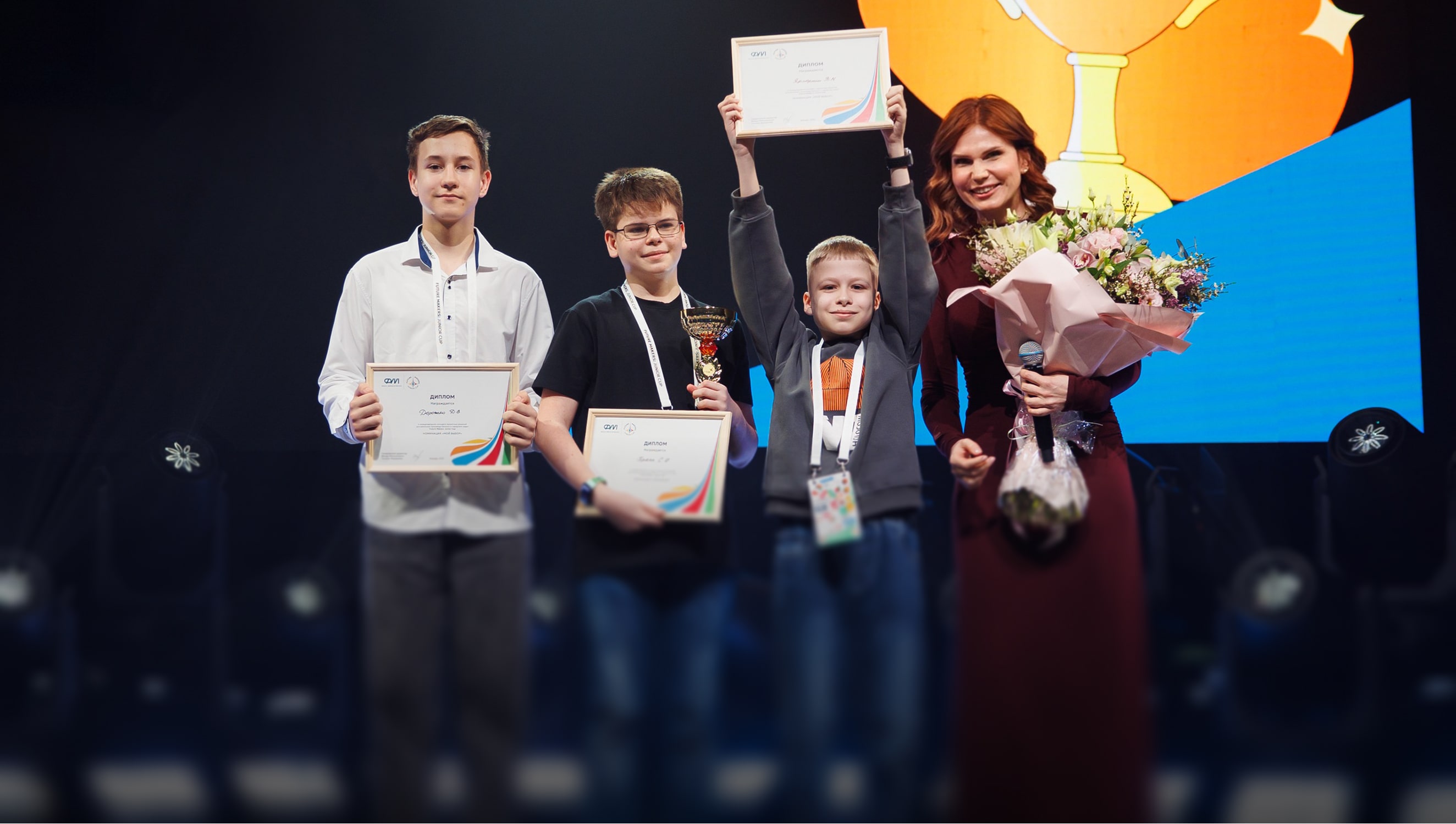
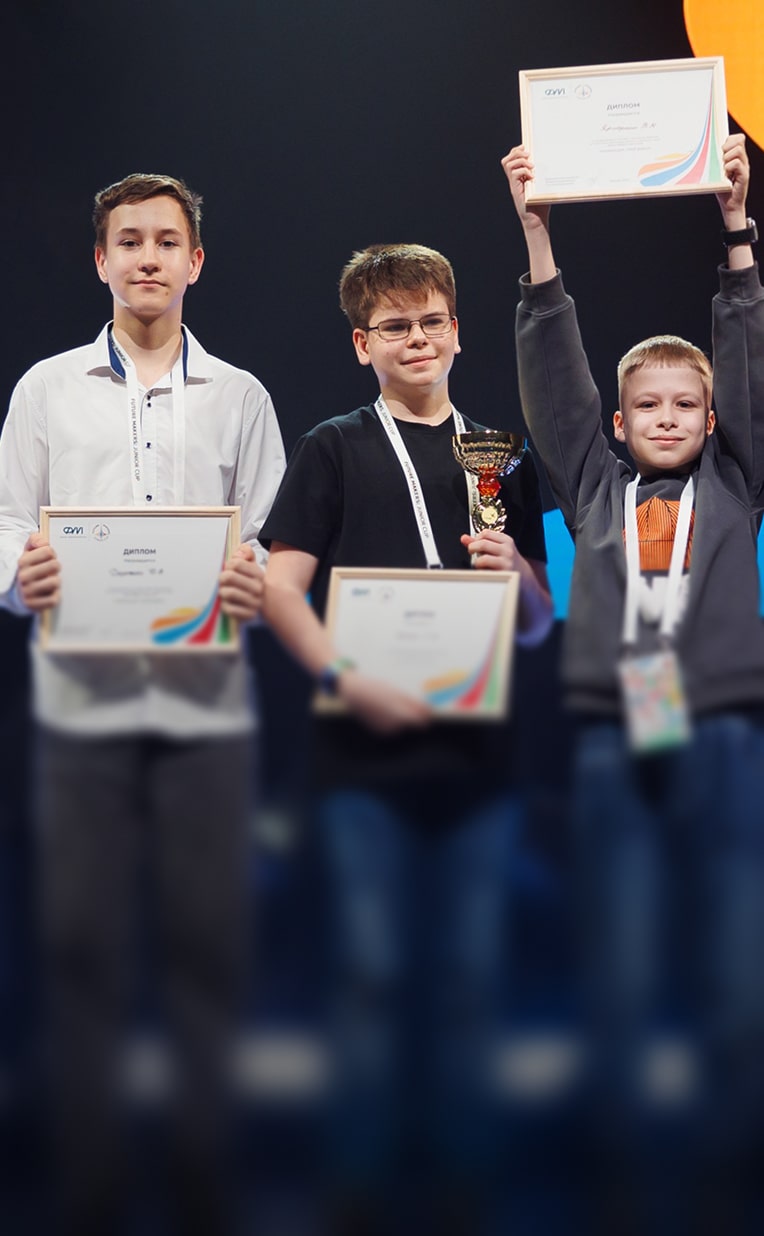

Take part in the international competition for design solutions for real-world industrial and urban challenges: Future Makers: Junior Cup
The competition is divided into two categories: the Engineering Cup and the Cities Cup. Each category features thematic challenges representing real-world cases, requiring innovative, creative, and understandable technical solutions
Junior
Cup
Who can participate?
Students of grades 5–11 who are citizens of the Russian Federation and study in general education programs at secondary schools
Undergraduate students (1st–2nd year) and college students up to 25 y.o. at the time of application, who are citizens of the Russian Federation or of countries listed in Appendix No. 9 of the Regulations, studying in higher or secondary vocational education programs
Undergraduate (3rd–6th year) and postgraduate students up to 25 y.o. at the time of application, who are citizens of the Russian Federation or of countries listed in Appendix No. 9 of the Regulations, studying in bachelor’s, specialist, or postgraduate programs at higher education institutions
The categories of the competition
Select tasks
Questions and answers
All competition challenges are provided by the Organizing Committee and belong to one of the two categories: Engineering Cup or City Cup.
- For the Engineering Cup, challenges are proposed by technical directors and chief engineers of Russia’s leading industrial enterprises — partners of the Foundation.
- For the City Cup, challenges are developed by municipal administrations in the regions where the Foundation’s partners operate.
At the preliminary stage, you will begin working on solving one of the tasks (individually or in a group). We have designed this stage to allow you to study best practices, create several hypotheses for possible solutions, select one, and begin to develop it. And at the Project School stage, we will teach you all the nuances of how to package your solution so that it is clearly described, becomes a full-fledged project application with an accompanying presentation, ready to be evaluated by the jury.
We recommend that you include adult and experienced mentors on your team. These could be teachers, research supervisors or anyone else who can help you with the chosen task for the competition. We will provide awards not only for the mentors of the winners, but also for the educational institutions where they study. So, feel free to involve your school administrators and teachers in your project!
Carefully review the list of tasks and determine if you have the necessary knowledge and skills to collect and analyze the data, develop a solution, perform the necessary calculations, and create a presentation. What are your own areas of strength? Who else, with what expertise, could enhance your chances of success in the competition? Where could you find such individuals? If you decide working alone will not bring success, you may wish to consider forming a team. Please note, however, that the maximum number of team members is limited to five, including the adult mentor.
Create a project plan outlining what needs to be done and setting the deadlines. By the start of the Project School (December 15), you should already have selected your challenge and begun working on it. If you prefer to work independently (without joining the Project School), make sure your plan includes all key stages: research, data collection, calculations, and description of your proposed solution. Consult your mentor when needed. Distribute roles within the team and set 2–3 progress checkpoints and deadlines. By February 1, your team should have a completed project application and a ready presentation describing your solution.
We welcome participants from grade 5 school students to postgraduate students (up to age 25 at the time of application). Teams may include students starting from grade 5.
The Final Round will take place in Moscow. Exact dates and venue details will be announced in early March. Travel expenses for finalists and their mentors will be covered by the competition organizers.
Use textbooks, research papers, expert articles, and online analytics. There’s plenty of free resources. Occasionally, we can provide clarifications through our Competition Partners.
Don’t worry if you’ve never presented before! Finalists will attend workshops to learn how to speak confidently and present effectively before the jury.
No, each participant may only join one team.
Potentially yes, but we do not recommend this format. If you reach the finals, you would need to leave the team and participate only as an individual.
Participation is allowed only for one task. Competing individually and as part of a team is also not allowed, even if the challenges are different.
Challenges are not reserved for a specific team or participant. Several participants or teams can work on the same task, which adds to the competitive nature of the competition.
Creating a Minimal Viable Product (MVP) is optional. The further you develop your solution, the higher your chances of success. If an MVP is feasible, try building and testing it—but a clear project plan and presentation are sufficient.
We recommend inviting experienced mentors — such as teachers or academic advisors — to join your team.
Mentors can guide you through the problem-solving process and help you refine your project.
So don’t hesitate to involve your teachers!

Partners